

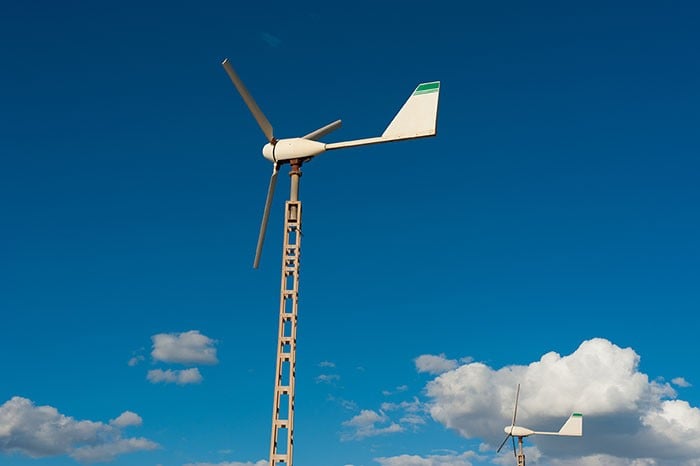
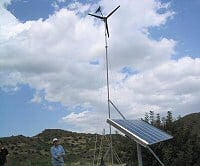
 Wind turbine systems for homes are one of the more cost effective forms of generating electricity from a renewable energy source if you have the right site. In general terms, a site that has at least a half acre of open land and average of 10 mph (16km/h) or higher winds is a good candidate for a wind turbine installation.
It is possible to have a system that only gets its power from wind, however, many people combine getting power from a wind turbine with getting power from a solar electric system. The two technologies are often complimentary: when there’s little sun (e.g. during the winter or when it’s overcast), there’s often more wind and vice versa.
The most commonly used wind turbines for homes are usually not very large – ranging from 3 feet (~1 meter) to 6 feet (~2 meters) in diameter. There are also some like the Bergey Excel which are as large as 22 feet (6.7 meters) in diameter and used for more energy consumptive homes or businesses.
Most of the small wind turbines that are available for use with individual homes and business produce no more noise than the wind would whispering through the leaves of a tree. Small wind turbines have also been shown to hurt fewer birds than glass patio doors that are so common on many US homes.
How It Works
 Just like solar electric systems, wind powered systems can be used in two ways: off-grid or on-grid. Off-grid is when your home or business is entirely disconnected from an electric utility company and you generate absolutely all of the electricity you need. Usually these systems cost about 30% more than an on-grid (or ‘grid-tie’ system). A grid tie wind power system sends all of its electricity back into the public electrical network (grid) which the electric company gives you credits for. At the month, the electric company sums up your credits with how much your home or business has consumed, and if you’re lucky the electric company will owe you money! Unfortunately, most electric companies only pay you a small fraction of what they charge you for those extra kilowatt-hours you’ve created. So it’s usually ideal to design a system that very closely offsets how much electricity you consume or just little less, than attempting to make money from the electric company.
Off-Grid Wind Power Systems
A basic wind power system will consist of:
- Wind turbine on top of a tower (1) that is wired down to a control box (2) that regulates the charging of a large deep cycle battery bank (3).
- An inverter (4) which draws electricity from the battery bank and converts to normal household electricity (AC) and feeds the appliances in the home with power as needed.
- Various safety devices like fuses, breakers and lightning arrestors (not shown in diagram).
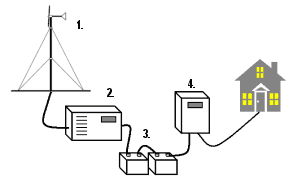
Diagram of an off-grid wind power system
On-Grid (Grid-Tied) Wind Power Systems
A grid-tied wind power system can have almost exactly the same components as the off-grid system except that inverter is a special inverter which connects directly to a utility meter (5) the public utility grid (6).
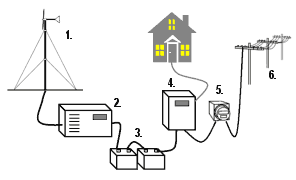
Diagram of a grid-tied wind power system with batteries
Increasingly, there are also systems which don’t use a battery bank at all – the electricity flows directly from the wind turbine into the special ‘grid-tie’ inverter and then into the grid. These straight grid-tie systems have the added advantages that they tend to be less expensive (no batteries to pay for) and more efficient (because the electricity doesn’t have to pass through the battery bank first). On the downside, if there’s a blackout then your wind turbine system will also shutdown and not be able to provide power to your home or business.
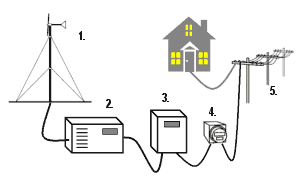
Diagram of a grid-tied wind power system without batteries
How Do I Get Started?
 Be an educated consumer! Chances are if you have read this far you are already an intelligent, product savvy person looking to optimize a renewable energy solution that has the right features and positive effects on your household or business that you want with cost. Here’s your itinerary for determining the right wind power solution for your needs:
- Energy Efficiency is always the #1 step. It’s estimate that for every $1 you spend on making your home more electrically efficient you save $3-$5 on the cost of a wind or solar electric system. By reducing your electrical demand you reduce the size of renewable energy system you’d need to purchase.
- Learn more about the basics of wind power in the Other Renewables section of our Resource Library. To get a very in-depth understanding of small wind turbines for homes and businesses, we highly recommend purchasing the books Wind Energy Basics and Wind Power For Home & Business by Paul Gipe.
- Call our knowledgeable sales staff with any questions or any help you might need in sizing a system. Our toll-free number is 1-877-878-4060. For customers outside of the US, Puerto Rico and Canada, please call 1-978-562-5858.
